Navigate the high-stakes legal conflicts redefining federal authority, provincial rights, and First Nations sovereignty across Canada.
Conflicts between provincial legislation and federal jurisdiction over First Nations sit at one of the most technically demanding intersections of Canadian public law. These disputes require more than a general understanding of Indigenous rights or federalism. They require lawyers to work through overlapping constitutional doctrines, including section 91(24), section 35, section 88 of the Indian Act, interjurisdictional immunity, federal paramountcy, treaty protection, and the constitutional limits on provincial laws of general application.
This course examines how constitutional principles are used to resolve conflicts where provincial laws affect First Nations, reserve lands, Aboriginal or treaty rights, Indigenous self-government, or federal legislative schemes. It considers the practical difficulty of determining when provincial legislation applies, when it is incorporated or limited by federal law, and when constitutional protections require the law to give way.
Participants will develop a structured framework for analysing jurisdictional conflict in Indigenous law. The session focuses on how to identify the source of the conflict, select the relevant constitutional doctrine, and apply legal principles in a careful, defensible and practice-ready way.
Key Topics Discussed:

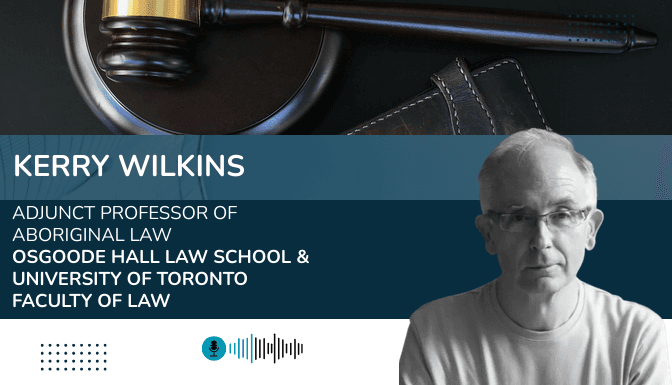
Adjunct Professor of Aboriginal Law | Osgoode Hall Law School & University of Toronto Faculty of Law
Kerry Wilkins, a recovering government lawyer, is adjunct professor of Aboriginal law at Osgoode Hall Law School and the University of Toronto Faculty of Law. He has written one book (Essentials of Canadian Aboriginal Law (Thomson Reuters, 2018)), edited another (Advancing Aboriginal Claims: Visions; Strategies; Directions (Purich, 2004)) and published a number of articles, usually about Indigenous peoples and/or the Canadian constitution, in Canadian law journals.
